The Theory That Refuses to Die: Giulio Douhet and Airpower as a Panacea
All views in this newsletter are my own and do not represent the views of The R Street Institute, the US Navy, or any other organization I am affiliated with.
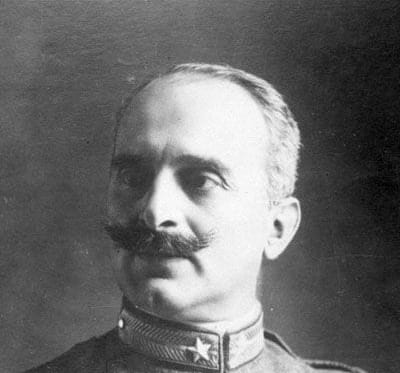
In 1921, Italian General Giulio Douhet published The Command of the Air. His book went on to become an extremely influential work in military strategy that put forth an elegant solution to the messy business of war: strategic bombing would reshape warfare in such a way that armies and navies would forever become obsolete. If properly applied, air power would be able to leapfrog opposing military forces and strike sites that would eradicate the enemy's will to fight. Cities would crumble, civilian morale would break, and governments would capitulate, all without the costly grinding ground campaigns and naval blockades that had characterized warfare throughout recorded history.
Discounting the fact that Douhet's theory brought the horrors of 20th Century industrial warfare from the battlefields to population centers and made civilians suffer in new and previously inconceivable ways, his theory provided military strategists with an attractive alternative. Targeting the population portion of Clausewitz's trinity could eliminate "passion" from the equation and bring wars to an end more quickly.
Douhet saw little glory from his work, spending years in a military prison for insubordination before dying in 1930. This is perhaps for the best, as he never saw his theory tested at scale, and therefore never had to see it fail across eighty years of modern warfare. Airpower is a critical piece of military capability; however, Douhet's theory has always overpromised and never delivered. Regardless of overwhelming evidence, we continue to believe it to be true.
The strikes on Iran that began in February of 2026 bring Douhet's thinking back to the forefront of American military strategy. Precision munitions, AI-enabled targeting, and overwhelming air superiority were used against Iran's nuclear facilities, military infrastructure, and regime leadership. The theory of victory couldn't be more Douhetian: destroy capability, eliminate leadership, and compel strategic change in Iran using airpower alone. While early indicators are showing that this is unlikely to be sufficient, whether this campaign will achieve those objectives remains an unanswered question. History shows us that Douhet's theory has never delivered on its promise.
What about Hiroshima?
Before fully exploring how Douhet's theory has consistently disappointed, I'd like to address the counterargument that I hear most frequently: What about Hiroshima and Nagasaki? Two bombs, Japan surrenders, and the war ends: doesn't this prove Douhet's theory that airpower can compel capitulation?
This argument ignores the fact that the atomic bombs were dropped after a multi-year combined arms campaign of staggering scope. The island hopping campaign across the Pacific came at an enormous human cost. Unrestricted submarine warfare had crippled Japanese shipping and cut off their supply lines for oil, raw materials, and food. The U.S. Navy, Army, and Marine Corps had established dominance across the Pacific theater. Planning was underway for the invasion of the Japanese mainland. The Soviet Union had just entered the Pacific war and was driving into Manchuria. Japan had already lost the war by August of 1945, it just hadn't officially acknowledged that fact.
Douhet's theory holds that airpower should replace armies and navies entirely and that reaching over and beyond opposing forces will directly break the enemy's will to fight and ground campaigns will be made unnecessary. Japan's surrender came after an aerial engagement, but also after years of amphibious, ground, air, and naval combat. To see this as a vindication of Douhet's theory is myopic.
The second problem with the Hiroshima counterargument is the nature of the bomb. Nuclear weapons have an entirely different coercive power than conventional strategic bombing. The threat from atomic bombs was total annihilation rather than mass destruction, bringing a completely different logic into play from Douhet's. Conflating nuclear weapons with their conventional counterparts is a false equivalence, they are categorically different weapons.
Douhet's Track Record
With the Hiroshima counterargument out of the way, any historical support for Douhet collapses entirely. Korea demonstrated that overwhelming air superiority couldn't prevent conditions on the ground from grinding to a stalemate. Operation Rolling Thunder in Vietnam was three years of sustained bombing against North Vietnam that failed to break Hanoi's will in any way. The Gulf War, often hailed as a vindicator of precision airpower, also required a 100-hour ground campaign with half a million troops to compel Iraq to withdraw from Kuwait. Back in Iraq in 2003, the regime fell in weeks to spawn an insurgency that no aerial targeting system could resolve.
A pattern for airpower begins to emerge after decades of lessons learned. Airpower has consistently proved itself invaluable for degrading enemy capabilities, reshaping the battlefield, setting conditions for combined military operations, and bringing the misery of warfare to civilian populations. It is a key contributor to modern warfare approaches that has never resolved the underlying political problems that cause war by itself. Resolution of conflicts has always required ground forces, diplomacy, and sustained presence (often for years after campaigns end).
We can go back to Clausewitz to examine why: war is the continuation of politics by other means. Military force is an instrument of policy, not a substitute for it. Douhet's thinking tries to bypass that essential relationship by destroying enough from the air that the political problem solves itself. This hasn't worked because of three key realities: political problems do not evaporate in the face of targeting lists, populations harden under bombardment rather than breaking, and regimes under pressure consolidate rather than collapsing. In short, the enemy gets a vote.
Technological Progress as a Renewal Mechanism
My thinking naturally turns to the question of why Douhet's theory persists in the face of overwhelming evidence to the contrary. The answer I come up with connects to the central concern of this newsletter: each generation of technological advances renews the faith in these theories and gives hope that this time, capability has finally hit the level where the promise will come true.
Daylight precision bombing in World War II would make strategic bombing accurate enough to make bombing as capable as Douhet described. Smart bombs in the Gulf War would make targeting so precise that military targets could be engaged in isolation and there would be no need to break civilian morale. GPS-guided munitions would further extend the same logic. Now we're talking about AI-enabled targeting to compress kill chains and eliminate all targeting errors. Precision is constantly improving, the theory continues to fail, yet the faith persists.
I've written about this phenomenon more broadly before (and it landed with a thud and an A- at the Naval War College). Alexis de Tocqueville noticed something important about the American psyche in 1840: Americans have a deep preference for practical, technical solutions over theoretical or more ambiguous ones. He dedicated an entire chapter of Democracy in America to the American preference for practical science over theoretical inquiry: our tendency to pursue knowledge to the point where it solves a concrete problem and no further. The airpower-is-enough fallacy seems to be one of the most durable expressions of this preference in the military domain: if we build a better bomb, a smarter targeting system, and a more precise munition, we don't have to do the hard work of ending wars because they will end themselves.
Airpower isn't a new domain of warfare, it's been a critical instrument of military might for decades now. The evidence of what its capabilities and limitations are is consistent and substantial. Further belief in precision being able to close the gap between Douhet's theory and operational reality is the same faith that drives the deus ex machina delusion across other facets of American policymaking. The assumption that political and strategic challenges can be resolved with the right technology, properly deployed misses that these challenges have no technological solution.
Technology is not the problem, but the belief in the sufficiency of technology as a solution certainly is.
What This Means For...
Policymakers: Strategic objectives require a thorough understanding of the capabilities and limits of strategic means. Airpower can degrade capabilities, destroy infrastructure, and shape conditions to achieve outcomes. It cannot resolve conflicts in a vacuum. Before going all in on air campaigns to achieve goals, ask what happens after the bombing stops. History suggests that question deserves more attention than developing a targeting list.
U.S. strategic competition: Douhet's theory assumes that the enemy will absorb punishment until the will of the people breaks. Strategic competitors will often study our theories of victory and build their own strategies around them. China's area denial strategy exists from watching decades of American campaigns. Adversaries aren't likely to share our deus ex machina delusion, but they will recognize it and build capability to neutralize those assets. Ironically, our persistent belief in airpower sufficiency may have led to systems that directly contest it.
Tech companies and defense contractors: AI-enabled targeting, autonomous weapons, and precision munitions are genuine advances in capability. They do not change the underlying logic of warfare. A faster kill chain does not supplant the need for a political objective that can be achieved through military force. Improvements at the tactical level will not automatically cascade to the operational or strategic levels of war.
Aspiring strategic thinkers: Notice how persistent Douhet's flawed theory is and ask why. The theory is elegant, intuitive, alluring, and (most importantly) wrong. Regardless, something about it makes it renew with each generation of military technology. This pattern reflects technological optimism's ability to color strategic judgment. The question that must be asked of any new military technology is not whether it is an improvement of prior capability, but whether it validates or defers judgment on the theories that accompany it.