The Fog Machine of War: How Information Technology Thickens the Fog of War Instead of Lifting It
All views in this newsletter are my own and do not represent the views of The R Street Institute, the US Navy, or any other organization I am affiliated with.
In March of 2003, The United States military invaded Iraq with the most networked fighting force ever seen in the history of warfare. Operation Iraqi Freedom (OIF) was the first operational test of 'net-centric' warfare doctrine that sought to connect sensors, shooters, and commanders across the battlespace. This was an ambitious endeavor that carried a significant promise: commanders would be able to achieve coup d'oeil, seeing and knowing everything, and acting faster than any adversary could respond. The fog of war, the persistent, irreducible uncertainty that Clausewitz warned about was finally going to be cleared through technological progress.
Then bandwidth limitations brought everyone back to reality.
The Congressional Research Service documented what happened in April of 2003. Bandwidth shortages forced units to abandon radio and computer switching equipment to triage message flow. As a result, units would make fighting decisions with outdated information as the enemy changed position faster than the information flow. At the same time, connection between operational units and theater commanders turned out to be less helpful than estimated as commanders thousands of miles away were now able to "interject unhelpful suggestions and questions into tactical operations." The Army War College released a great case study on net-centric warfare in the V Corps and the 3rd Infantry Division that documents the gap between the promise of connectivity and what it delivered under operational stress.
It's important to note that the invasion portion of OIF was not a failure as the regime fell in just three weeks. The experience surfaced a pattern the deus ex machina delusion reliably produces: when technology meets reality, the complications it generates can be just as significant as the problems it was meant to solve.
Another Theory that Just Won't Quit
The belief that technology can eliminate the fog of war isn't a new phenomenon and it predates the Iraq invasion by almost a century. In 1909, Field Marshal Alfred von Schlieffen described a future where commanders would have a detailed awareness of the battlespace from afar and be able to directly manage battles from a distance. Sixty years later, General William Westmoreland made a near-identical argument, predicting a battlefield so transparent that commanders would see and react to everything in real time and bring a transformational precision to warfare.
Neither vision has materialized and war is still blanketed by a thick fog of complexity, friction, and the irreducible uncertainty of the most violent of human affairs.
Nevertheless, the Department of Defense has pursued this fantasy for decades, spending billions on the same vision with different names. The Net-centric warfare doctrine of the 1990s and early 2000s gave way to 'effects-based operations' until General James Mattis deemed its foundational principles as "fundamentally flawed" due to their ambiguity. Perhaps overlooked in Mattis' guidance was a quote of General Sherman: "every attempt to make war easy and safe will result in humiliation and disaster." Undeterred, the Department continued to pursue this same concept under the name of Joint All-Domain Command and Control (JADC2) with nearly unchecked spending. The Pentagon spent an estimated $2.2 Billion across thirty separate initiatives in 2023 and requested $1.4 Billion in funds for JADC2 in 2024. The concept doesn't have a budget line, is not a program of record, and has limited operational demonstration after years of development, leaving Congress to ask repeatedly what is being pursued and what are the objective and threshold measures of success.
My critique of this concept is not novel. Rear Admiral W.J. Holland wrote in the Naval Institute's Proceedings about this in April of 2003 stating that "it isn't difficult to see the fog of war being replaced by the fog of systems."
Why Complexity Always Thickens the Fog
In "On War," Clausewitz is specific about what creates friction in war. There is always a gap between theoretical plans and chaotic reality, and the cumulative effects of small complications that may seem manageable on their own make "the simplest things difficult" when combined. Information Technology doesn't inherently reduce sources of friction, often it adds new ones.
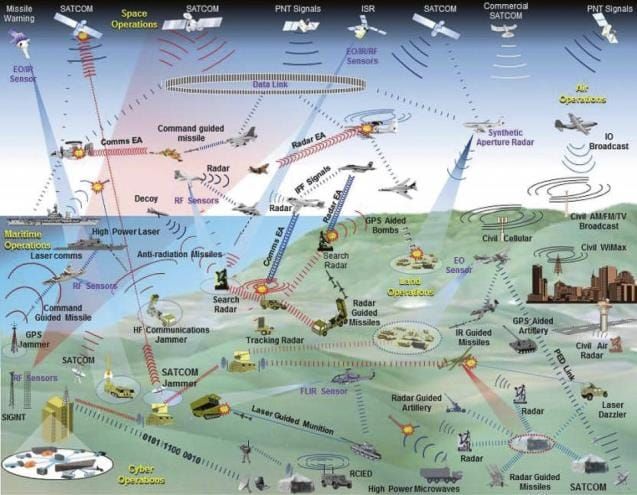
Having more connected systems really means that more people will be receiving data under stress. This will result in more opportunities to panic, misinterpret, or freeze. More nodes in a network provide more points of failure, more attack surfaces, and more dependencies that can cascade failures through systems. More data flowing to theater commanders means more cognitive load when clarity, speed, and decisiveness matter more than optimality. More connectivity between senior officers and tactical units means more opportunities for micromanagement to override mission command: why bother with commander's intent when the commander can talk to you directly? All of these factors degrade the ability for decentralized military operations to succeed.
There is a deeper problem in this network as well that technology solutions like JADC2 cannot resolve. Connecting sensors to shooters and sending information faster does nothing to solve the problem of knowing what information matters and how long it remains relevant. A common operating picture shared with everyone still needs human judgment to interpret, prioritize, and act upon - even with Artificial Intelligence. More data bears no guarantee of better decisions and in some operational environments, more data will slow the decisionmaking process as commanders wait for clarity to emerge from the fog on the ground.
The fog of war emerges not from a lack of data, it is inherent in the chaotic nature of war itself. Clausewitz understood this, but Americans are fighting the perpetual belief that the next generation of technology layered on top of past efforts (the deus ex machina delusion) will yield to a revolution in operational command and control. (I examined this same pattern last week through the lens of air power.)
The Money Vacuum
The pursuit of JADC2 matters from a defense spending perspective in ways that are more important than it being a wasteful pursuit with no meaningful oversight. The promise of total battlespace awareness is an example of a compelling theoretical vision that justifies further investment regardless of results, because the failure of the current instance is not attributed to a flawed theory, but insufficient capability. Net-centric warfare didn't succeed in 2003 because American forces weren't networked enough. Effects-based operations didn't succeed because we didn't have enough sensors and data. JADC2 hasn't delivered because we need more integrated systems-of-systems. Through each of these failures to deliver, the theory has been preserved, investment continues, and Clausewitz wonders how all those officers who read "On War" at War Colleges forget his teachings so easily.
I should note that this is not some luddite screed against investing in new capability in communications, connectivity, and command and control modernization or the integration of AI into military systems. These capabilities matter and services are right to pursue them. My argument is against the specific theory that connectivity and data sharing will eliminate strategic uncertainty as well as the spending patterns that this theory continues to generate. Spraying a firehose of billions at achieving information dominance means that funding cannot go toward logistics, training, and readiness - the unglamorous things that actually contribute to military effectiveness.
The fog machine runs on the same faith in technological sufficiency that fuels the broader deus ex machina delusion: the conviction that political and strategic problems can be engineered away with the right system. This is never true in warfare: the enemy adapts, the network degrades, the fog returns anew.
What This Means For...
Policymakers: JADC2 has consumed billions with no single program of record, no clear metrics, and limited operational demonstration. Congress has been asking the right questions about accountability and results. Before approving continued spending increases on information dominance concepts, demand demonstrated performance against the specific friction points that have defeated previous iterations of the same theory. Connectivity is worth funding. The claim that connectivity eliminates strategic uncertainty is not.
U.S. strategic competition: China's military modernization has studied American net-centric warfare doctrine carefully and drawn the obvious conclusion: if the US military depends on networked connectivity for its operational effectiveness, then degrading that connectivity is a decisive strategic objective. Chinese investments in electronic warfare, anti-satellite capabilities, and cyber operations target the network specifically. A theory of victory that depends on information dominance hands adversaries a clear and concentrated target.
Defense contractors and tech companies: The JADC2 market will continue to generate significant contract opportunities. But the pattern of net-centric warfare, effects-based operations, and now JADC2 suggests that concepts promising to eliminate fog and friction have shorter operational lives than their procurement timelines. Companies building toward demonstrated tactical utility in degraded network environments will be better positioned than those optimizing for a seamlessly connected battlespace that operational reality rarely provides.
Aspiring strategic thinkers: Clausewitz's friction principle is not a historical curiosity. It is a description of something irreducible in the nature of complex human conflict. When you encounter a policy, doctrine, or technology that promises to eliminate uncertainty rather than manage it, you are looking at a theory that will eventually fail on contact with reality. The question is how much gets spent before that happens.