AI Grand Strategy Option 6: Standards and Governance Leadership
All views in this newsletter are my own and do not represent the views of The R Street Institute, the US Navy, or any other organization I am affiliated with.
This is the seventh installment in the Grand Strategy for AI Competition series. The first piece examined why the "AI race" metaphor fails and introduced Kennan's grand strategy framework. The second outlined Preserve Democratic Technological Autonomy. The third examined Resilience Over Dominance. The fourth examined Competitive Pluralism. The fifth examined Technological Interdependence. The sixth examined Innovation Ecosystem Dominance. This week: the second offensive approach, and the one that most directly shapes the rules of the game.
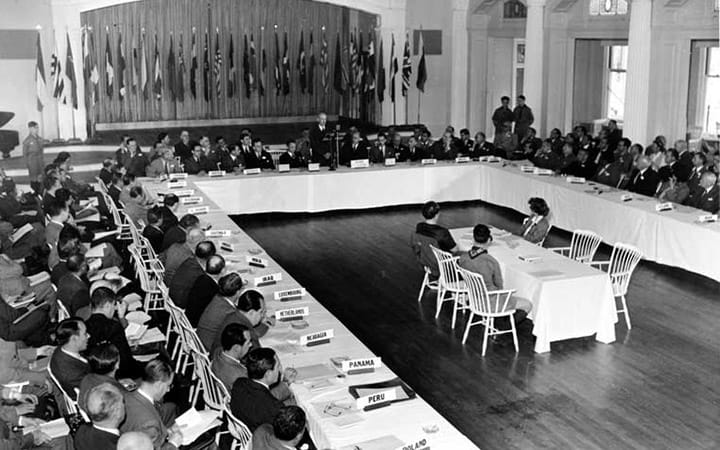
In July 1944, while the Second World War was still being fought, 730 delegates from 44 Allied nations gathered at the Mount Washington Hotel in Bretton Woods, New Hampshire. They spent three weeks negotiating the postwar international monetary order. By the time they left, they had created the International Monetary Fund, the World Bank, and a dollar-centered exchange rate system that would govern global finance for decades and place the United States at the center of world affairs.
The American delegation, led by Treasury official Harry Dexter White, arrived with a plan already written. The US had done the intellectual work before anyone else arrived. Other nations brought concerns, British economist John Maynard Keynes brought an alternative proposal, and there was genuine negotiation. At the end of the day, the architecture that emerged bore the unmistakable mark of American priorities: the dollar as reserve currency, institutions designed to channel capital in ways favorable to American economic interests, rules that locked in the advantages of the world's largest creditor nation.
The strategic insight that Bretton Woods represents isn't simply that the US won the war. It's that the US designed the postwar system before the war ended, and that design compounded for eighty years. Countries participating in IMF and World Bank frameworks operated under rules written in Washington. The dollar's reserve currency status became a structural advantage no military victory could have secured. It's too simple to say that the US won. It wrote the rules that winners and losers alike would have to follow going forward.
This is the historical logic behind Standards and Governance Leadership as a grand strategy for AI competition.
Writing the Rules
Last week's installment examined Innovation Ecosystem Dominance, a strategy that builds compounding advantages by creating conditions for generative innovation. I characterized that approach as offensive but passive: build the ecosystem, get out of the way, let the advantages accumulate. Standards and Governance Leadership is more actively directed. The goal isn't just to out-innovate competitors. It's to define what "trustworthy," "safe," and "interoperable" mean for AI systems globally, so that the technical and regulatory architecture reflects democratic values and creates structural advantages for AI built under democratic accountability frameworks.
The political objective maps directly onto the Bretton Woods logic: design the system before others define it for you. Whoever writes the standards that govern how AI systems are audited, certified, and made interoperable across markets shapes what gets built, how it gets deployed, and who can participate in global AI markets. This creates structural advantages that compound over time, exactly as the dollar's reserve currency status compounded after 1944.
The venues for this competition are specific and already active. The International Telecommunication Union, the International Organization for Standardization, and the IEEE are where technical standards for AI safety, transparency, and interoperability are being written right now. These organizations represent the governing architecture for global AI deployment, and US presence in them is the price of influence over it.
The Brussels Mistake
Before examining how this strategy could work, it's worth examining the most prominent recent attempt at it, which reveals how the strategy can fail when the underlying logic is wrong.
The European Union's AI Act was designed in part to produce what analysts call the "Brussels Effect": the phenomenon by which EU regulations become de facto global standards because companies selling into Europe's 450 million consumer market find it cheaper to apply EU rules everywhere than to maintain separate compliance regimes. The GDPR became a global privacy standard this way. EU chemicals regulations shaped global manufacturing. Brussels was betting the AI Act would do the same.
It's not working. Research from CEPA found that as of 2025, only Canada, Brazil, and Peru showed any genuine interest in replicating the AI Act's framework. Leading companies have already delayed product launches in Europe rather than comply. The Brussels Effect may be running in reverse: instead of setting global standards, the AI Act risks placing Europe in its own regulatory ecosystem that stands completely apart from global innovation.
The reason is a category error. The Brussels Effect works for product standards because companies can't easily maintain separate supply chains for European and non-European markets. AI software is more divisible than chemicals. Chinese AI developers aren't primarily selling into European consumer markets. The leverage mechanism that made GDPR global doesn't reach Beijing's AI labs.
But the deeper problem is strategic, not technical. The Brussels Effect is fundamentally a market leverage play: comply with our rules or lose access to our consumers. Bretton Woods was something different. Countries didn't join the IMF because they feared losing access to American markets. They joined because the system created genuine stability and access to capital they wanted. The architecture was attractive, not coercive. Participation generated positive-sum benefits that made membership valuable.
The EU tried to run Bretton Woods logic using Brussels Effect mechanics. The result is a framework that constrains democratic AI development, generates compliance costs that advantage large incumbents over innovative startups, and has produced almost no global uptake outside of Europe's near abroad. This is the wrong model, and the US should resist any temptation to adopt it.
China's Bretton Woods Play
While Western attention has focused on the EU AI Act and its governance ambitions, China has been executing something considerably closer to the actual Bretton Woods playbook, and it has been doing so for over a decade.
China's approach to international standards bodies has been systematic, patient, and strategic. Beginning with a 2006 State Council directive explicitly calling for China to participate in international standards development and promote Chinese standards globally, Beijing has subsidized Chinese entities to contribute to the ISO, IEC, and ITU. It has placed Chinese nationals in senior leadership positions within key working groups. Chinese entities backed 145 new standards proposals at the ITU in 2021, up from 46 in 2015, six times the Western rate. In 2015, China secured the ITU Secretary-General position, which it held until 2023.
This reflects a deliberate strategy to define the technical architecture of global digital systems in ways that embed Chinese preferences and create structural advantages for Chinese technology. At the 2025 World AI Conference, Premier Li Qiang announced a 13-point action plan for global AI governance that explicitly called for leveraging the ITU, ISO, and IEC to "accelerate the revision and formulation of technical standards." China is not merely participating in standards bodies. It is running a standards strategy.
The goal isn't akin to the logic of the Brussels effect, where China would seek to impose Chinese domestic regulations on other countries. Instead, China is seeking to define the technical infrastructure so that systems built according to Chinese standards interoperate seamlessly with Chinese AI ecosystems while creating friction for competitors. It is the Bretton Woods move: write the rules of the system rather than competing from within someone else's framework.
In Newsletter 4, I examined China's use of Liddell Hart's indirect approach in technology competition: establishing dependencies that make direct resistance costly rather than confronting American advantages head-on. Standards leadership is the most sophisticated version of this approach. You don't win by building better AI. You win by defining what "better" means in the first place.
The American Credibility Problem
Standards and Governance Leadership is arguably the most powerful long-term strategy in this series, which makes the current state of American engagement in standards bodies particularly concerning.
The US has structural advantages that should make this strategy natural. American AI labs generate a disproportionate share of the research that technical standards are built on. American universities train most of the world's AI researchers. American capital funds the AI systems that global markets are adopting. The dollar-denominated capital flows that fund AI development globally give American financial institutions visibility into AI investment patterns no other country enjoys. The Bretton Woods logic applies: the US has the structural position to write the rules.
But Bretton Woods required sustained, consistent multilateral engagement over decades. American foreign policy has made that kind of commitment increasingly difficult to credibly promise. Withdrawal from international institutions, inconsistent multilateral commitments, and standards bodies that have been chronically under-resourced and under-staffed have created a credibility gap that China has filled systematically.
The EU AI Act's limited uptake reflects this credibility problem from a different angle. Countries looking for an AI governance framework to adopt aren't finding a coherent American alternative to Brussels. The US has influence over specific standards processes but no integrated strategy for AI governance leadership comparable to what it produced at Bretton Woods. The vacuum is real, and China's 13-point action plan is explicitly designed to fill it.
What Standards Leadership Actually Requires
The Bretton Woods analogy clarifies what this strategy demands. In 1944, the US didn't show up to Bretton Woods with vague platitudes about international cooperation and it certainly didn't denounce the value of international cooperation. It arrived with a specific architecture already designed, with technical staff who understood the details, and with the economic leverage to make its preferred outcome the negotiated outcome. It also created institutions that were genuinely valuable to participants. Countries joined the IMF not because America forced them to but because membership provided real benefits.
Effective AI standards leadership requires the same combination. It means sustained, expert-level engagement in the ITU, ISO, IEC, and IEEE processes where AI standards are actually being written. It means developing a coherent American position on what AI requirements should look like technically, before those questions get answered by default through Chinese participation. It means building the institutional architecture with democratic allies to make those standards genuinely attractive to developing nations choosing between Chinese and democratic AI ecosystems. Most importantly, it requires recognizing that standards leadership cannot be outsourced to industry alone, because China's state-backed approach to standards participation doesn't leave room for market-driven processes to fill the gap.
This is more actively directed than Innovation Ecosystem Dominance and more institutionally demanding than any of the defensive approaches in this series. Its honest limit is the same as Bretton Woods: you can design the architecture, but you have to show up consistently enough that others believe you'll maintain it. On current trajectory, that is precisely the commitment American policy has the most difficulty making.
What This Means For...
Policymakers: Standards bodies are not technical backwaters. They are the venues where AI governance architecture is being designed, and American absence is not neutral. The evidence-based policy question isn't whether to engage in ITU and ISO processes but whether current engagement is resourced and coordinated enough to shape outcomes rather than merely observe them. Developing a coherent American position on AI technical standards, staffing standards body participation as a strategic priority, and working with democratic allies to make those standards genuinely attractive to developing nations are the actual requirements of this strategy. Treating international standards engagement as an afterthought while China treats it as a national priority is not a policy. It is a concession.
U.S. strategic competition: China is not trying to ban American AI or block American market access. It is writing the infrastructure layer that will determine whether future AI systems are interoperable with Chinese ecosystems or American ones, whether auditability requirements reflect democratic accountability or state control, and whether the technical standards that govern global AI deployment embed values compatible with democratic governance or not. That is a Bretton Woods competition, not a Brussels Effect competition. Winning it requires the kind of institutional patience and multilateral engagement that has characterized America's least successful foreign policy periods lately.
Tech companies: Standards body participation has historically been undervalued as a strategic activity. For AI systems that need to operate across global markets, the standards being written now at ITU and ISO will determine certification requirements, interoperability specifications, and compliance frameworks for decades. Companies with technical expertise in AI have both a stake in and an obligation to contribute to democratic standards processes. Leaving those venues to state-backed Chinese participation is not a neutral market decision. It shapes the regulatory environment those companies will operate in.
Aspiring strategic thinkers: Bretton Woods was not a battlefield win. It was won in conference rooms by people who understood that designing the postwar architecture mattered more than any single military victory. The same logic applies to AI governance. The question isn't who builds the best AI systems in 2026. It's who writes the standards that define what AI systems should be in 2035. The US has the structural position to answer that question. Whether it has the strategic patience and institutional commitment to act on that position is a different question entirely.