AI Grand Strategy Option 4: Technological Interdependence
All views in this newsletter are my own and do not represent the views of The R Street Institute, the US Navy, or any other organization I am affiliated with.
This is the fifth installment in the Grand Strategy for AI Competition series. The first piece examined why the "AI race" metaphor fails and introduced Kennan's grand strategy framework. The second outlined an approach to Preserve Democratic Technological Autonomy, the defensive approach built on containment and the Monroe Doctrine. The third examined Resilience Over Dominance, drawing on Rome's recovery from Cannae and the Soviet Union's inability to adapt. The fourth examined Competitive Pluralism, drawing on the Concert of Europe's management of great-power rivalry. This week: a grand strategy built on a premise that sounds almost absurd given current trends.
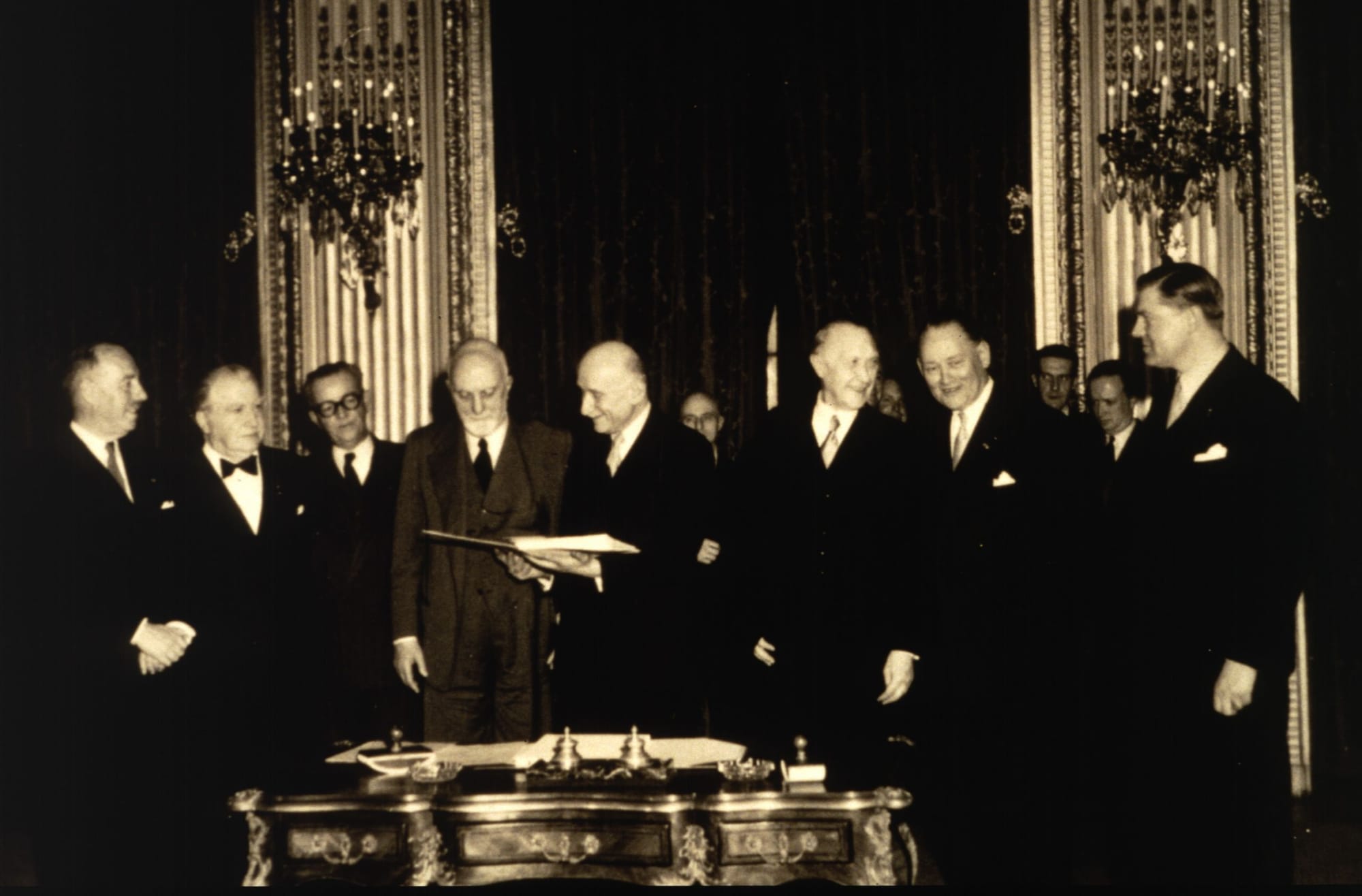
On May 9, 1950, French Foreign Minister Robert Schuman walked into a press conference and proposed something that would have been considered lunacy five years earlier. France and Germany, he announced, should pool their coal and steel production under a common authority. This wasn't a gesture of goodwill. Nor was it a diplomatic nicety. This deliberate and sweeping restructuring of the European economy was designed to make war between them physically impossible.
The logic was specific, not sentimental. Coal and steel were the sinews of industrial warfare. You needed them to build tanks, warships, and aircraft. Every major European war of the preceding century had been fought with French and German coal and steel. If you pooled that production under a joint authority, if you made French and German industrial capacity genuinely inseparable, you couldn't wage war against your partner without simultaneously destroying the economic foundation of your own war effort. In this arrangement, dependency was the whole point rather than a side effect.
The European Coal and Steel Community, established in 1951, achieved its goal of preventing war among European powers. It was certainly not perfect and this arrangement was not without friction. Yet by the time it evolved into the European Economic Community and eventually the European Union, the Franco-German rivalry that had produced three catastrophic wars in seventy years had become functionally inconceivable. In the last newsletter, we examined Metternich's Concert of Europe, a diplomatic achievement that held great-power peace through consultation and managed competition. The ECSC achieved something more durable. As a body, the ECSC didn't manage the rivalry. What it did was restructure the incentives until the rivalry between France and Germany lost its most dangerous expression.
Jean Monnet, the French economist who designed the plan, understood something that pure diplomacy couldn't deliver. While agreements based on goodwill require persistent goodwill to maintain them, architectures based on mutual dependency can be sustained even by pure self-interest.
The Uncomfortable Premise
Technological Interdependence as an AI grand strategy begins with a premise that inverts almost everything in current U.S. policy: strategic stability in AI competition might require deepening certain dependencies rather than eliminating them.
The dominant logic of current policy runs entirely in the opposite direction, and it does so deliberately. Export controls, investment restrictions, data localization requirements all represent a conscious choice to fragment rather than integrate. In a previous newsletter, I examined how this logic replicates 17th-century mercantilism, treating knowledge flows like precious metals to be hoarded rather than infrastructure to be shared. The Technological Interdependence strategy pushes further: it suggests that some form of structured mutual dependency between the United States and China might actually serve American strategic interests better than the decoupling we're currently pursuing.
This isn't an argument that China is trustworthy. Monnet didn't need to trust postwar Germany either — the architecture did the trusting for him. He proposed the ECSC because he understood that structural incentives are more reliable than diplomatic promises. The Washington Naval Treaty failed because it rested on promises alone. Japan made the promise and then built the Yamato anyway. The ECSC succeeded because French and German economic interests became genuinely intertwined. Breaking the arrangement would have hurt France as badly as Germany.
The strategic question Technological Interdependence asks about AI is this: are there domains where structured mutual dependency could create genuine constraints on conflict, not because either side promises restraint, but because the costs of disruption fall on both simultaneously?
What the ECSC Actually Did
It's worth being precise about the mechanism, because the AI application depends on understanding it correctly.
The ECSC didn't eliminate French and German competition. French and German steel companies competed aggressively for decades after 1951. What the ECSC eliminated was the ability to use industrial capacity as a unilateral weapon. You couldn't nationalize German steel to fund a war against France without simultaneously disrupting the supply chains your own economy depended on. The interdependence created shared vulnerability, and shared vulnerability changed the strategic calculus.
Three elements made this work. The dependency was genuine and symmetric, with France needing German coal as much as Germany needed French steel. The authority governing the arrangement was supranational rather than bilateral, meaning neither party could unilaterally rewrite the rules when convenient. The economic benefits of participation were real enough that both sides had positive reasons to maintain the arrangement, not just fears of the costs of abandoning it.
All three of those conditions matter for thinking about AI. Genuine and symmetric dependency. Governance that neither party controls unilaterally. Positive economic incentives for continued participation. The absence of any one of them produces something that looks like interdependence but functions more like a trap.
The Honest Tension
Here is where the historical parallel requires the same intellectual honesty the last newsletter applied to the Concert of Europe's eventual collapse.
The ECSC worked because both parties entered it wanting integration. France and Germany had just fought two catastrophic wars in thirty years. They shared a continent and an economic geography that made separation genuinely costly. And crucially, neither party was strategically committed to using interdependence as a weapon of coercion. They were both trying to escape a cycle of conflict, not win it.
The United States and China are not in that position. Both are actively looking for ways to decouple. This makes Technological Interdependence genuinely difficult to evaluate honestly: China has demonstrated that it treats economic integration not as mutual constraint but as strategic leverage. I've previously written about China's "indirect stickiness" approach, using infrastructure investment, standards influence, and supply chain positioning not to create symmetric vulnerability but to create one-sided dependency. BYD's European manufacturing commitments, which helped the company outsell Tesla in Europe despite facing 27% tariffs, and China's $79 billion in Digital Silk Road investments in developing-country digital infrastructure, are designed to make partners dependent on China without creating equivalent Chinese dependency on them.
Monnet's ECSC was designed to eliminate asymmetric leverage by creating genuine symmetry. China's integration strategy is designed to maximize asymmetric leverage by deliberately avoiding it. If Technological Interdependence as a grand strategy is going to work, it has to solve this problem. Interdependence that is one-sided isn't interdependence. It's a dependency relationship, and dependency relationships favor the less-dependent party.
There's a version of this that might still be achievable. TSMC's foundry capacity, which manufactures the advanced chips powering virtually every major AI system, creates genuine leverage in multiple directions simultaneously. Neither the United States nor China fully controls this chokepoint, and both have strategic interests in its continued functioning. Academic and research networks, despite growing restrictions, still create professional relationships and shared knowledge that carry strategic value. Standards bodies, when they function, create interoperability that benefits participants enough to sustain participation. These aren't the clean architecture of the ECSC. But they're not nothing, either.
The question is whether these partial and messy interdependencies can be reinforced and extended deliberately, or whether the current decoupling trajectory will eliminate them before their strategic value is recognized.
The Monnet Warning
Monnet's insight, that architecture is more reliable than goodwill, cuts both ways as a warning.
If the strategic goal is creating genuine mutual constraint through interdependence, then asymmetric arrangements work against the goal. Every dependency that runs one direction creates leverage for the less-dependent party rather than constraint on both. And if one party is deliberately engineering asymmetric dependencies while the other is pursuing mutual ones, the result isn't interdependence. It's the strategic situation China's indirect stickiness approach is designed to create.
The ECSC succeeded in part because Monnet had enough political space to design the architecture carefully before locking it in. We are not in that position with AI. The dependencies that exist are the product of two decades of economic integration that neither government designed with strategic logic in mind. Some of those dependencies are genuinely symmetric. Others are not. Distinguishing between them, and figuring out which ones are worth preserving versus which represent strategic vulnerabilities to reduce, requires a level of analytical precision that the current "decouple everything" policy approach doesn't attempt.
Technological Interdependence as a grand strategy isn't an argument for naive openness. It's an argument that structured dependency, carefully designed to be symmetric and governed through frameworks neither party controls unilaterally, can create more durable stability than either dominance or simple containment. Whether that architecture can still be built, given where the relationship is now, is the honest question this strategy cannot answer.
What This Means For...
Policymakers: The ECSC's insight is that architecture beats promises. If Technological Interdependence has strategic merit, it requires identifying domains where genuine symmetric dependency can be structured and maintained, not hoping that existing trade relationships produce it automatically. Before accelerating decoupling in any domain, the evidence-based question is whether the dependency being severed is asymmetric (a strategic vulnerability) or symmetric (a constraint on both parties). The current approach doesn't consistently make that distinction.
U.S. strategic competition: China's indirect stickiness strategy is a version of Monnet's insight turned asymmetric. Beijing is engineering dependency in others while maintaining its own strategic flexibility. A Technological Interdependence response requires either creating genuine symmetry, with dependencies running in both directions with real costs on both sides, or recognizing that the window for that architecture may already be closing. Competing effectively against an indirect stickiness strategy requires understanding what you're competing against.
Tech companies: Interoperability and open standards aren't just technical preferences or commercial conveniences. Under a Technological Interdependence framework, they're the infrastructure through which symmetric dependency gets built and maintained. Companies that build for interoperability preserve options. Companies that build for lock-in, whether intentionally or as a byproduct of competitive strategy, contribute to exactly the asymmetric dependency that makes the ECSC model impossible to replicate.
Aspiring strategic thinkers: Monnet understood something that most strategists miss: the most durable constraints on conflict aren't promises, they're incentive structures. The ECSC didn't ask France and Germany to be peaceful. It made conflict economically irrational. When evaluating any proposed arrangement between rivals, the right question isn't "do both parties promise to abide by this?" It's "what happens to both parties if either one defects?" If the costs of defection are asymmetric, the arrangement will eventually fail in the direction that favors the less-constrained party.