AI Grand Strategy Option 3: Competitive Pluralism
All views in this newsletter are my own and do not represent the views of The R Street Institute, the US Navy, or any other organization I am affiliated with.
This is the fourth installment in the Grand Strategy for AI Competition series. The first piece examined why the "AI race" metaphor fails and introduced Kennan's grand strategy framework. The second made the case for Preserve Democratic Technological Autonomy — the defensive approach built on containment and the Monroe Doctrine. The third examined Resilience Over Dominance, drawing on Rome's recovery from Cannae and the Soviet Union's inability to adapt. This week: a grand strategy that begins with an admission that makes most policymakers deeply uncomfortable.
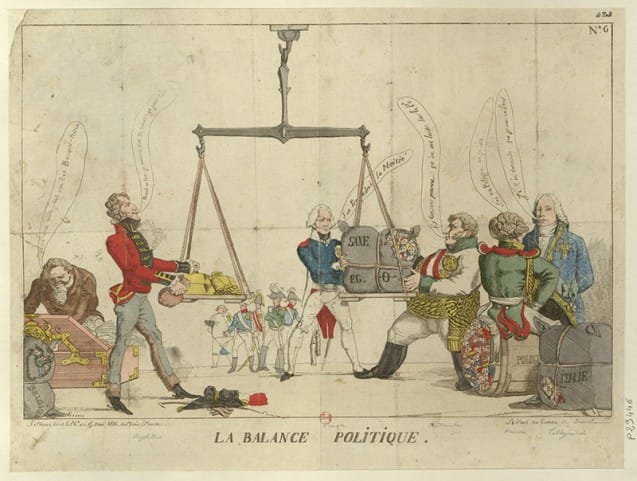
In September 1814, the most consequential diplomatic conference in European history convened in Vienna. Europe was exhausted after twenty-three years of nearly continuous war. This violent period began with the French Revolutionary Wars and culminated in Napoleon's final defeat. Continental Europe had been completely shattered. Somewhere between three and six million soldiers were dead. Economies were ruined. The old order had been turned inside out.
The obvious (and emotionally satisfying) response would have been to punish France. Strip it of territory, isolate it diplomatically, and ensure it could never threaten European stability again. Unsurprisingly, this was a popular position. The British public largely wanted this. So did significant factions in every victorious power.
Austrian Chancellor Klemens von Metternich and British Foreign Secretary Lord Castlereagh did something else entirely. They brought France back into the diplomatic order almost immediately. Within three years, France was a full participant in the Concert of Europe, a great-power consultation mechanism established by the Congress of Vienna. France was included not because they had become a trustworthy international actor. Instead, Metternich and Lord Castlereagh understood something counterintuitive: a Europe that tried to permanently exclude France from the great-power system would be destined to fail. France was too large, too central, too consequential to be wished away. The strategic question wasn't how to eliminate French power. It was how to manage it within a framework that prevented any single power — including France — from achieving hegemony.
The system they built held. From 1815 to 1914, there was no general European war (the Crimean War, while involving great powers, remained geographically and politically contained — exactly as Concert logic intended). Regional conflicts were locally constrained rather than spreading. The great powers consulted rather than mobilized. It wasn't a utopian scenario. It was deeply conservative, and it suppressed nationalist movements that eventually couldn't be contained. As a mechanism for preventing catastrophic hegemonic war among great powers, it held long enough that historians still debate exactly when it ended — which is itself evidence that something was working.
I want to be honest about why competitive pluralism is uncomfortable to apply to AI competition. It requires accepting something that runs counter to almost everything in current U.S. technology policy.
The Uncomfortable Premise
Competitive Pluralism as an AI grand strategy begins with this premise: China will develop advanced AI. Not as a failure of policy. Not as a temporary setback. As a strategic reality that no combination of export controls, investment restrictions, or technology denial can prevent over a multi-decade timeline.
This isn't a defeatist outlook. The first newsletter in this series established that Kennan's containment (the last coherent American grand strategy) succeeded not because it prevented Soviet development across the board, but because it defined achievable strategic objectives and aligned instruments of national power accordingly. The Soviet Union developed nuclear weapons, space capabilities, and significant conventional military power throughout the Cold War. Containment's goal was never to prevent Soviet capability development entirely. It was to prevent the USSR from achieving hegemony and imposing Soviet governance models on others without their consent.
Competitive Pluralism applies the same logic to AI. The strategic objective isn't to maintain permanent American AI superiority across every domain. It's to prevent any single actor, China (or for that matter any other power including the United States) from achieving hegemonic control over AI development pathways that would allow them to impose a single governance model on the rest of the world.
The distinction matters. It changes what success looks like, which changes what tools are appropriate, which changes what we should and shouldn't do.
What the Concert Actually Did
Metternich's Concert of Europe wasn't just a peace treaty. It was an active management system with specific mechanisms. The great powers agreed to consult through congresses and conferences when crises emerged. They agreed that the fundamental purpose of the system was preventing any power from dominating the continent. Critically, they agreed that all great powers, including recently defeated ones, had a legitimate seat at the table.
The system had no written rules and no permanent institutions. Any great power could call a congress when it felt a crisis required collective management. The powers didn't have to agree on values, political systems, or economic arrangements. They agreed on one thing: hegemony by any single power was unacceptable, and maintaining the system that prevented it was in everyone's interest.
It was, in other words, a framework for managed competition among actors with fundamentally incompatible values and interests. Sound familiar?
Why the Concert Collapsed
Here is where the historical parallel gets important and honest. The Concert of Europe didn't last forever. It began to fray in the 1860s and effectively ended with the rigid alliance system that replaced it.
The mechanism of failure is instructive. Bismarck's post-unification diplomacy from 1871 to 1890 was, in many ways, a continuation of Concert logic. He managed German power within a framework designed to prevent any single combination from dominating the continent. His genius was using complexity to prevent the very hegemonic coalitions that German strength would otherwise have provoked. When Kaiser Wilhelm II dismissed Bismarck in 1890 and declined to renew the Reinsurance Treaty with Russia, Germany abandoned restraint in favor of Weltpolitik. This put Germany in an explicit pursuit for world power status.
The consequences were immediate. Russia allied with France. The flexible consultation system hardened into rigid blocs. When the Austro-Hungarian ultimatum to Serbia triggered mobilization in 1914, the alliance system dragged everyone in automatically. The Concert's whole purpose of localizing conflicts through great-power consultation had been replaced by its opposite. Countries entered into binding commitments that guaranteed escalation during crises.
The Concert of Europe didn't cause World War I. The failure to maintain Concert principles caused World War I. Rigidity replaced flexibility. Hegemonic ambition replaced managed competition.
What Competitive Pluralism Would Actually Require
Applying this to AI competition reveals something most current policy discussion ignores: what the strategic objective is determines what the strategic instruments should be.
If the goal is preventing AI hegemony and ensuring that no single governance model becomes the global default by virtue of lock-in, dependency, and the absence of alternatives, then the relevant question isn't primarily about who has the best AI system today. The relevant question becomes: can multiple capable actors with incompatible values remain able to develop and govern AI according to their own frameworks, while being able to manage the interactions between those frameworks?
That's a very different problem than winning a race. It implies preserving the conditions for managed competition rather than eliminating a competitor. It suggests that some Chinese AI development isn't the strategic problem — Chinese AI hegemony is the strategic problem. The difference matters enormously for policy.
Under this framework, the most dangerous outcomes aren't a world where China has capable AI. They're worlds where AI infrastructure becomes so consolidated, either in the U.S. or China, that alternatives become economically or technically infeasible. This world would be one where interoperability is replaced by lock-in, where the consultation mechanisms that would allow great powers to manage AI-related crises don't exist because no one built them during the period when building was still possible.
The Concert of Europe succeeded for nearly a century not because the great powers liked each other. They REALLY didn't. It succeeded because Metternich and Castlereagh built active management mechanisms during the post-Napoleonic window when everyone was exhausted enough to accept them. We may have a similar window now. The time to adopt this strategy would be before AI capabilities become so advanced, and AI governance conflicts so entrenched, that pluralism becomes genuinely impossible to maintain.
The Bismarck Warning
The cautionary tale of the historical parallel is worth sitting with. Bismarck's restraint was as much a personal achievement as an institutional one. When Wilhelm II replaced his disciplined management with Weltpolitik, the system came apart faster than anyone anticipated. Concert principles require active maintenance. They don't sustain themselves.
The AI equivalent of Wilhelm II dropping the Reinsurance Treaty is the point at which any great power decides that the constraints of managed competition are no longer worth accepting, and begins pursuing capability dominance across all domains regardless of how other powers respond. History suggests the response will be coalitions, rigidity, and eventual catastrophe.
Metternich was remembered by liberals of his era as a reactionary. He was, in many ways. But he understood something his critics didn't: in a multipolar system, the most dangerous actor is the one that decides the rules don't apply anymore. That insight is as relevant to AI governance as it was to 19th-century European diplomacy.
What This Means For...
Policymakers: The goal of Competitive Pluralism is preventing AI hegemony, not preventing Chinese AI development. These are different strategic objectives that require different instruments of national power. Evidence-based strategy asks what specific outcomes would constitute hegemonic lock-in — consolidated infrastructure dependencies, eliminated alternatives, absent governance mechanisms — and works backward from there. The Concert didn't try to eliminate French power. It built a system that channeled it.
U.S. strategic competition: The Bismarckian warning applies directly. American restraint within a managed competition framework is harder to maintain than to abandon. But the historical record suggests that abandoning it to pursue dominance rather than pluralism triggers exactly the coalitions and rigidity that make outcomes worse. The question isn't whether America can win an AI race. It's whether winning an AI race, as currently defined, actually serves American strategic interests over a multi-decade horizon.
Tech companies: A Competitive Pluralism framework implies something the current policy environment obscures: interoperability and open standards aren't just technical preferences, they're the infrastructure of managed competition. Companies that build for interoperability preserve the conditions under which pluralism remains viable. Companies that build for lock-in can contribute to exactly the hegemonic consolidation that eventually triggers political backlash severe enough to constrain everyone.
Aspiring strategic thinkers: Metternich's concert is one of the most underrated achievements in diplomatic history, partly because its success is invisible. The wars that didn't happen between 1815 and 1914 are hard to count. This is the fundamental challenge of grand strategies built on maintaining pluralism rather than achieving dominance: they work by preventing catastrophes, and prevented catastrophes leave no evidence. The frameworks that hold the system together look like bureaucratic procedure right up until the moment they collapse.